Monday, December 20, 2010

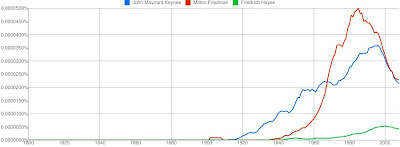
Intellectual Impact and Trend: An Experiment

Based on word count stats from the Google books database. An Ngram is subsequence of n words from a given sequence.

1. Keynes vs. Friedman vs. Hayek
2. Coase vs. North vs. Williamson

3. Agency theory vs. Transaction cost economics vs. Property rights theory vs. RBV
4. Neoclassical economics vs. Behavioral (& Experimental) economics

Friday, October 8, 2010

Nobel Odds

Latest stats from iPredict:

Oliver Hart 27.5%
Richard Thaler 24%
Jean Tirole 20.86%
Robert Shiller 20.86%
Martin Weitzman 17.75%
William Nordhaus 17%
Angus Deaton 11%
Eugene Fama 7.82%
Avinash Dixit 7.5%
Robert Barro 6.91%
Ernst Fehr 5.18%
Gene Grossman 5.05%
...

And The Simpsons also provide a bet (via O&M):

ummm...Williamson to win the Physics Prize? For what? His demonstration that integrated particles are created by strong force due to physical matter specificity? In fact, the prize in physics went to a former Ig Nobelist because he successfully discovered something by using a scotch tape.

Tuesday, October 5, 2010

How to get a REAL Nobel?

One way is...to get an Ig Nobel first --

From the Nobel Committee: "The Nobel Prize in Physics 2010 was awarded jointly to Andre Geim and Konstantin Novoselov 'for groundbreaking experiments regarding the two-dimensional material graphene'. "

From Improbable Research: "The Ig Nobel Prize in Physics 2000 is presented to Andre Geim and Michael Berry for using magnets to levitate a frog. "

Now we got a clue.

Monday, September 27, 2010

Award the Creativity

Among 2010's WSJ Technology Innovation Awards winners are computer screens that can bend, adjustable eyeglasses, a low-cost genetic test, an online marketplace for receivables and a new way to battle malware.

Wednesday, September 22, 2010

Who will win?

According to Thomson Reuters Prediction:

Alberto Alesina for theoretical and empirical studies on the relationship between politics and macroeconomics, and specifically for research on politico-economic cycle

Nobuhiro Kiyotaki & John H. Moore for formulation of the Kiyotaki-Moore model, which describes how small shocks to an economy may lead to a cycle of lower output resulting from a decline in collateral values that creates a restrictive credit environment

Kevin M. Murphy for pioneering empirical research in social economics, including wage inequality and labor demand, unemployment, addiction, and the economic return of investment in medical research, among other topics

Monday, September 20, 2010

Infectious Talk

For those of you who enjoy listening to new ideas rather than reading (particularly true when you are cooking or driving), you may definitely try a couple of these interviews (including Paul Romer, Arnold Kling, and Josh Lerner).

Monday, September 6, 2010

Manage your bibliography is just one-click away

I started to use Zotero - a Firefox plugin - to manage numerous categories of academic papers, books and their bibliographic information, and it was soooo amazing! By just clicking a small button at the end of the address bar, you can easily import the link of an article from various online sources and databases, like JSTOR, ScienceDirect, Google Books, Amazon and so on, and its citation information is also automatically loaded.

When you are writing an article, it is also very easy to create a list of references using Zotero. For instance, if you are using the Word processor, all you need to do is to highlight the list of papers you want to cite in your Zotero window and drag them onto the Word file you are using. Different citation styles are also available to be chosen.

You can also easily creat groups, share your libraries with friends and colleagues, and synchronize all your library information if you are invited to some other groups.

Hat tip to Todd.
Sunday, May 30, 2010

Recommended Posts

From Organizations and Markets:
The release of the Handbook of the Economics of Innovation (Intro, Vol I, II)
Nicolai Foss on the Assumptions in the Management Research (also some comments there)
A Recent Workshop on Organizational Economics and Organizational Capabilities

From the Project Syndicate:
Identity Economics (also a talk here by Akerlof, and Q&A)

Aside: why acupuncture could reduce pain?

From Scientific American.

"Scientists tried the technique on mice that had a pain in the paw, inserting and rotating the needles in the mouse version of one of the most effective acupoints in Chinese medicine. And they found that the tissues around the treated acupoint get flooded with adenosine, a chemical that provides relief by preventing pain signals from reaching the brain.

This biochemical blockade reduced the animals’ discomfort, as did treating them with drugs that boost the amount of adenosine in the tissue. The scientists say the pain relief stems from the body’s natural response to minor tissue injury. So acupuncture’s analgesic effect may have finally been pinned down."

Monday, May 17, 2010

Randomized Control Trials...or not?

Do we need more field experiements and RCTs in doing empirical economics or do we need to rely on alternative methods and develop new econometric techniques? Duflo's Clark Medal has triggered some methodological debates among the development economists recently (see here and here). One possible alternative (as they cite Acemoglu's piece) is to rely more on structural models in which data for counterfactuals could easily be simulated rather than collected via field trials.

To me, this is just another around of methodology debate between the reduced form school and the structural school. Any deep issues aside, for graduate students, it might be a safer strategy if we can do both.

Saturday, May 1, 2010

Curbing Risk on Wall Street

Oliver Hart and Luigi Zingales promote again (here for the previous piece) their ideas for a market-based trigger (rise in CDS price) to induce regulators' actions in regulating financial institutions and restraining risks on Wall Street.