A group of organizational economists have just celebrated the 25th anniversary of the groundbreaking work of Grossman and Hart (1986) (HT to Peter Klein). As a strategy student and a great admirer of the property rights school, I myself also have written a small essay to celebrate this day, where I bring two closely related and widely influential theories namely, PRT and Transaction Cost Economics (TCE) together and offered a brief comparison of the two schools, their critiques, and how they have and may futher shed great light on the future of strategy research.
TCE and PRT: Compare, Contrast and Critique
Tuesday, June 28, 2011

Four commencement speeches
All four speeches were given by famous TV talkshow hosts. Hilarious in their own styles and contents, they were nevertheless all truly entertaining and engaging, and has successfully left the audience with not only laughter, but also with sweet memories and valuable reflections.
1. Oprah Winfrey's 2008 Stanford University Commencement Address.
2. Ellen DeGeneres's 2009 Commencement Speech at Tulane University.
3. Conan O'Brien's 2011 Dartmouth College Commencement Address.
4. Stephen Colbert's 2011 Commencement Speech at Northwestern University.
1. Oprah Winfrey's 2008 Stanford University Commencement Address.
2. Ellen DeGeneres's 2009 Commencement Speech at Tulane University.
3. Conan O'Brien's 2011 Dartmouth College Commencement Address.
4. Stephen Colbert's 2011 Commencement Speech at Northwestern University.
Monday, June 27, 2011
Sunday, April 24, 2011
Are you a jerk in the workplace?
In his book The No Asshole Rule, Stanford business professor Robert I. Sutton pointed out that, jerks in your workplace not only worsen morale and productivity but also impose huge costs to the company as a whole. Readers can also take a self-rating questionnaire to see whether they themselves are "certified" assholes or not.
To me, I think it is also interesting to ask, whether assholes at the top of the corporate ladder have more negative impacts on the company than those at the middle or the bottom? Are there certain traits or charateristics to a boss that are more likely to attract (expel) jerks to (away from) his/her leadership? If so, what are those traits? Moreover, the author has dealt a lot with bullying behavior in the workplace, but such behavior is mostly explicit, jerks and assholes sometimes do more harm to their coworkers by stabbing them in the back, stirring things up or setting people at loggerheads, which are more implicit and hard to detect. Then does the specified rule in the book apply to these activities also? Or how can we do about them?
To me, I think it is also interesting to ask, whether assholes at the top of the corporate ladder have more negative impacts on the company than those at the middle or the bottom? Are there certain traits or charateristics to a boss that are more likely to attract (expel) jerks to (away from) his/her leadership? If so, what are those traits? Moreover, the author has dealt a lot with bullying behavior in the workplace, but such behavior is mostly explicit, jerks and assholes sometimes do more harm to their coworkers by stabbing them in the back, stirring things up or setting people at loggerheads, which are more implicit and hard to detect. Then does the specified rule in the book apply to these activities also? Or how can we do about them?
Saturday, April 16, 2011
Jonathan Levin wins Clark Medal
The American Economic Association has announced that this year's John Bates Clark medal was awarded to Stanford University economist Jonathan Levin for his "influential research on the economics of contracting, the organization and design of markets, subprime lending, and on empirical methods for studying imperfect competition."
Also see here, here and here.
Also see here, here and here.
Friday, April 15, 2011
Friday, March 18, 2011
Dan Ariely takes on Malcolm Gladwell
Dan Ariely, author of Predictably Irrational, recently turned himself into a podcaster for his own channel, Arming the Donkeys. This week, he had a conversation with the best selling author, Malcolm Gladwell, discussing about social science, storytelling and how to write bestselling books.
Check it out on iTunes.
Check it out on iTunes.
Wednesday, March 9, 2011
Behavior on two sinking ships
Imagine you were on a sinking ship, people around you were running, screaming and crying. A great panic was clearly underway and you soon realized this was a life-or-death situation and of course, you, like anybody else, want to survive. Now what would you do? Will you fight your way through to reach the lifeboat or will you be such a gentleman and follow the norm of letting the women and children go first? A recent study shows that, this really depends.
Using two datasets from two real accidents, the sinking of Titanic and Lusitania, researchers found out that under extreme conditions, people may behave drastically different. One critical factor is the scarcity of time.
"...differences in context are likely to matter in life-or-death situations. The comparison between the Titanic and the Lusitania suggests that when time is scarce, individual self-interested flight behavior predominates, while altruism and social norms and power through social status become more important if there is suffificient time for them to evolve..."
Sounds plausible, but a more myterious question is further imposed, how long will be sufficient enough to develop an altruistic norm? Aren't there always people with quite stable altruistic preferences? Why wouldn't these preferences take over instantly? What's the relationship between the severity of the situation and the time we need to develop an altruistic norm?
Also, there could be other important but untouched factors, one of which is the cause of the disaster. Whether the situation is totally man-made or largely natural may have direct effects on people's behavior.
Using two datasets from two real accidents, the sinking of Titanic and Lusitania, researchers found out that under extreme conditions, people may behave drastically different. One critical factor is the scarcity of time.
"...differences in context are likely to matter in life-or-death situations. The comparison between the Titanic and the Lusitania suggests that when time is scarce, individual self-interested flight behavior predominates, while altruism and social norms and power through social status become more important if there is suffificient time for them to evolve..."
Sounds plausible, but a more myterious question is further imposed, how long will be sufficient enough to develop an altruistic norm? Aren't there always people with quite stable altruistic preferences? Why wouldn't these preferences take over instantly? What's the relationship between the severity of the situation and the time we need to develop an altruistic norm?
Also, there could be other important but untouched factors, one of which is the cause of the disaster. Whether the situation is totally man-made or largely natural may have direct effects on people's behavior.
Tuesday, March 8, 2011
Shoe thrower index
The Economist has come up with an unrest ranking for the Arab world. They weighted-averaged a couple of key indicators to get the vulnerability indices for each Arabian country. The key factors include, years in power for the current ruler (15%), population that are under 25 (5%), percentage of this population to the whole (35%), GDP per capita (PPP, 10%), democracy level (15%), corruption index (15%), and finally, an index of censorship that proxies the freedom of speech (5%). Guess who is up on the front?
Monday, December 20, 2010
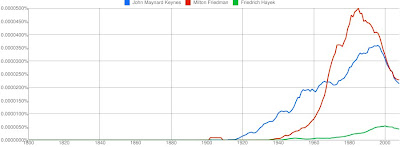
Intellectual Impact and Trend: An Experiment
Based on word count stats from the Google books database. An Ngram is subsequence of n words from a given sequence.
 2. Coase vs. North vs. Williamson
 3. Agency theory vs. Transaction cost economics vs. Property rights theory vs. RBV
 4. Neoclassical economics vs. Behavioral (& Experimental) economics
1. Keynes vs. Friedman vs. Hayek
2. Coase vs. North vs. Williamson3. Agency theory vs. Transaction cost economics vs. Property rights theory vs. RBV 4. Neoclassical economics vs. Behavioral (& Experimental) economics Friday, October 8, 2010
Nobel Odds
Latest stats from iPredict:
Oliver Hart 27.5%
Richard Thaler 24%
Jean Tirole 20.86%
Robert Shiller 20.86%
Martin Weitzman 17.75%
William Nordhaus 17%
Angus Deaton 11%
Eugene Fama 7.82%
Avinash Dixit 7.5%
Robert Barro 6.91%
Ernst Fehr 5.18%
Gene Grossman 5.05%
...
And The Simpsons also provide a bet (via O&M):
Oliver Hart 27.5%
Richard Thaler 24%
Jean Tirole 20.86%
Robert Shiller 20.86%
Martin Weitzman 17.75%
William Nordhaus 17%
Angus Deaton 11%
Eugene Fama 7.82%
Avinash Dixit 7.5%
Robert Barro 6.91%
Ernst Fehr 5.18%
Gene Grossman 5.05%
...
And The Simpsons also provide a bet (via O&M):

Tuesday, October 5, 2010
How to get a REAL Nobel?
One way is...to get an Ig Nobel first --
From the Nobel Committee: "The Nobel Prize in Physics 2010 was awarded jointly to Andre Geim and Konstantin Novoselov 'for groundbreaking experiments regarding the two-dimensional material graphene'. "
From Improbable Research: "The Ig Nobel Prize in Physics 2000 is presented to Andre Geim and Michael Berry for using magnets to levitate a frog. "
Now we got a clue.
From the Nobel Committee: "The Nobel Prize in Physics 2010 was awarded jointly to Andre Geim and Konstantin Novoselov 'for groundbreaking experiments regarding the two-dimensional material graphene'. "
From Improbable Research: "The Ig Nobel Prize in Physics 2000 is presented to Andre Geim and Michael Berry for using magnets to levitate a frog. "
Now we got a clue.
Monday, September 27, 2010
Award the Creativity
Among 2010's WSJ Technology Innovation Awards winners are computer screens that can bend, adjustable eyeglasses, a low-cost genetic test, an online marketplace for receivables and a new way to battle malware.
Wednesday, September 22, 2010
Who will win?
According to Thomson Reuters Prediction:
Alberto Alesina for theoretical and empirical studies on the relationship between politics and macroeconomics, and specifically for research on politico-economic cycle
Nobuhiro Kiyotaki & John H. Moore for formulation of the Kiyotaki-Moore model, which describes how small shocks to an economy may lead to a cycle of lower output resulting from a decline in collateral values that creates a restrictive credit environment
Kevin M. Murphy for pioneering empirical research in social economics, including wage inequality and labor demand, unemployment, addiction, and the economic return of investment in medical research, among other topics
Alberto Alesina for theoretical and empirical studies on the relationship between politics and macroeconomics, and specifically for research on politico-economic cycle
Nobuhiro Kiyotaki & John H. Moore for formulation of the Kiyotaki-Moore model, which describes how small shocks to an economy may lead to a cycle of lower output resulting from a decline in collateral values that creates a restrictive credit environment
Kevin M. Murphy for pioneering empirical research in social economics, including wage inequality and labor demand, unemployment, addiction, and the economic return of investment in medical research, among other topics
Subscribe to:
Posts (Atom)